ESG Risk Platform

My role
Product Designer & Product Manager (0→1 platform owner)
5 months
Bengaluru, India
Climate Tech
Challenge
ESG data is fragmented, hard to trust, and often not decision-grade. Fund managers, investors, and executives struggle with unreliable emissions data, static reports, and no clear way to model climate risk or validate disclosures. Our goal was to build a platform that brings everything under one roof metrics, modeling, materiality, and verification in a way that’s actually usable and aligned with how capital allocators think.
Results
The platform helped early users cut ESG reporting time in half and identify high-risk assets using climate transition modeling. Teams used the validator marketplace to add third-party assurance to their disclosures. Feedback from fund managers and sustainability leaders highlighted the platform’s clarity, credibility, and how it changed their ESG workflow from reactive to proactive.
2
Logistics companies onboarded during pilot phase, covering over 500 assets across operations.
5
Independent ESG validators onboarded to the marketplace for emissions and disclosure assurance.
92%
of users said the materiality module helped them focus on the most relevant ESG issues
Problem Space & User Needs
As ESG regulations accelerated, companies and investors faced growing pressure to report and act but the tools to do that were scattered, inconsistent, and often built for compliance, not decision-making.
We spoke to investors, fund managers, and sustainability leads across industries, and a few themes kept repeating.
Stakeholders

Anika Mehra, ESG-Focused Fund Manager
"I need reliable, comparable ESG data across my portfolio not PDFs and guesswork. I want to spot exposure early, run scenarios, and present a credible strategy to our LPs."

Carlos D’Souza, Chief Sustainability Officer
"We're juggling regulations, internal targets, and board expectations. I need one place to track emissions, validate data, and prioritize material topics for the business."

Maya Shah, Reporting Lead ESG & Compliance Team
"We’re juggling GRI, ISSB, CSRD, TCFD and client-specific formats on top of that. We need clarity on what to report, why it matters, and how to prioritize without starting from scratch every time."
Approach
Before starting product development, we conducted competitive analysis and market mapping across ESG reporting, climate modeling, and emissions tracking platforms. We looked at offerings from MSCI, Workiva, Watershed, and emerging players like Good.Lab to understand gaps in how current tools serve fund managers and sustainability teams.
In early research, we interviewed stakeholders across three segments: fund managers, sustainability leads, and reporting/compliance teams. These conversations helped us uncover critical pain points around fragmented ESG workflows, lack of scenario tools, and the overwhelming complexity of aligning with frameworks like GRI, CSRD, and TCFD.
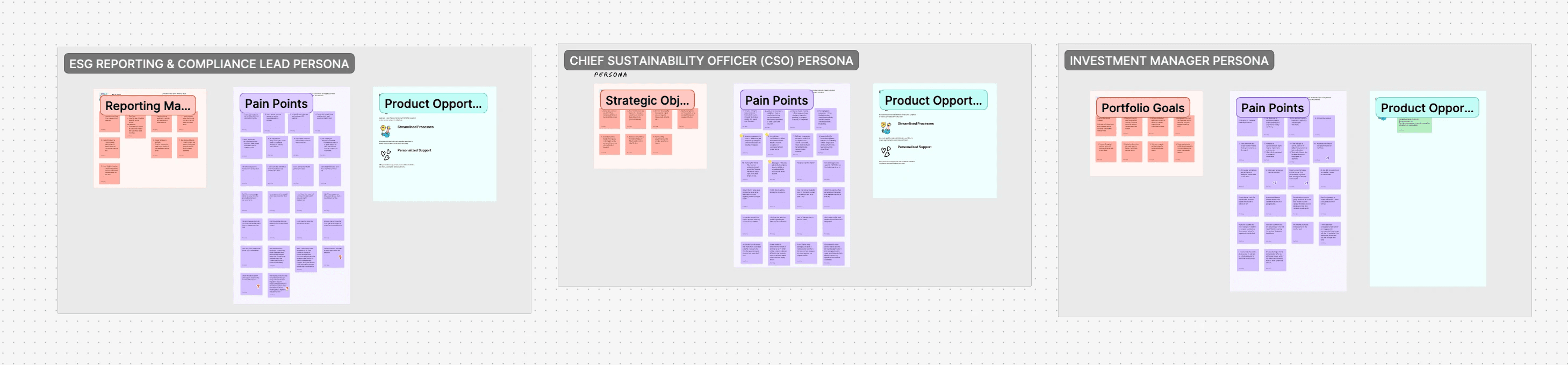
We synthesized user needs by clustering feedback using affinity mapping and created three representative personas to guide product thinking. These helped us reframe the problem around trust, clarity, and actionability in ESG workflows not just reporting.
From there, we defined the MVP, prioritizing features that delivered immediate value, emissions measurement (Scope 1–3), a materiality module, and a lightweight scenario engine. We intentionally scoped the validator marketplace for pilot with a curated group of firms to test the verification workflow.
On the design side, we ran multiple design sprints and iterated on mid-fidelity prototypes in Figma. We tested key flows like onboarding, dashboard views, and validator workflows with early users. Based on feedback, we simplified navigation, added contextual help around climate scenarios, and built role-based dashboards for fund managers, CSOs, and execs.
Pilot Partners
We conducted our initial pilot with two organizations operating in the clean mobility and logistics space.
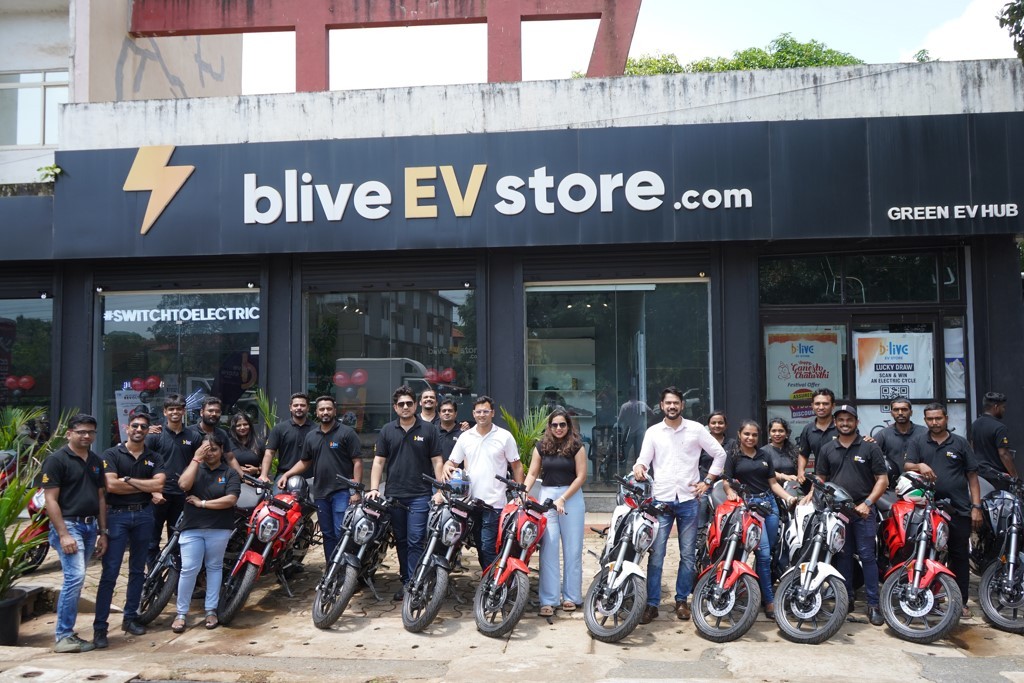
Blive is a quick commerce delivery partner platform focused on electric two-wheeler logistics. Their distributed fleet operations made them an ideal testing ground for our emissions tracking, ESG data collection, and validator integration features.

Good Energy, our sister company, provides fleet electrification solutions for enterprises. Their internal ESG and compliance teams helped us refine early workflows around transition modeling, framework alignment (like CSRD/GRI), and reporting clarity.
Contextual Inquiry
For this phase, we conducted 1:1 contextual interviews with sustainability leads, fund managers, and reporting officers from both pilot partners and external advisory networks. Our goal was to understand the real workflows, roadblocks, and expectations surrounding ESG measurement, emissions reporting, and audit readiness.
We carefully crafted our questions to explore how teams currently track emissions, navigate frameworks (like GRI, CSRD, ISSB), and manage validation. These conversations revealed deep frustration with disconnected tools, Excel-heavy processes, and the difficulty of translating ESG data into board-level insights.

Affinity Mapping
We mapped out our interview insights using digital sticky notes in FigJam. Individual observations were grouped into local affinity clusters based on recurring themes such as emissions tracking, framework fatigue, and validation workflows. These clusters were then organized into a structured three-layer affinity map to surface broader behavioral patterns, pain points, and emerging opportunities across user roles.
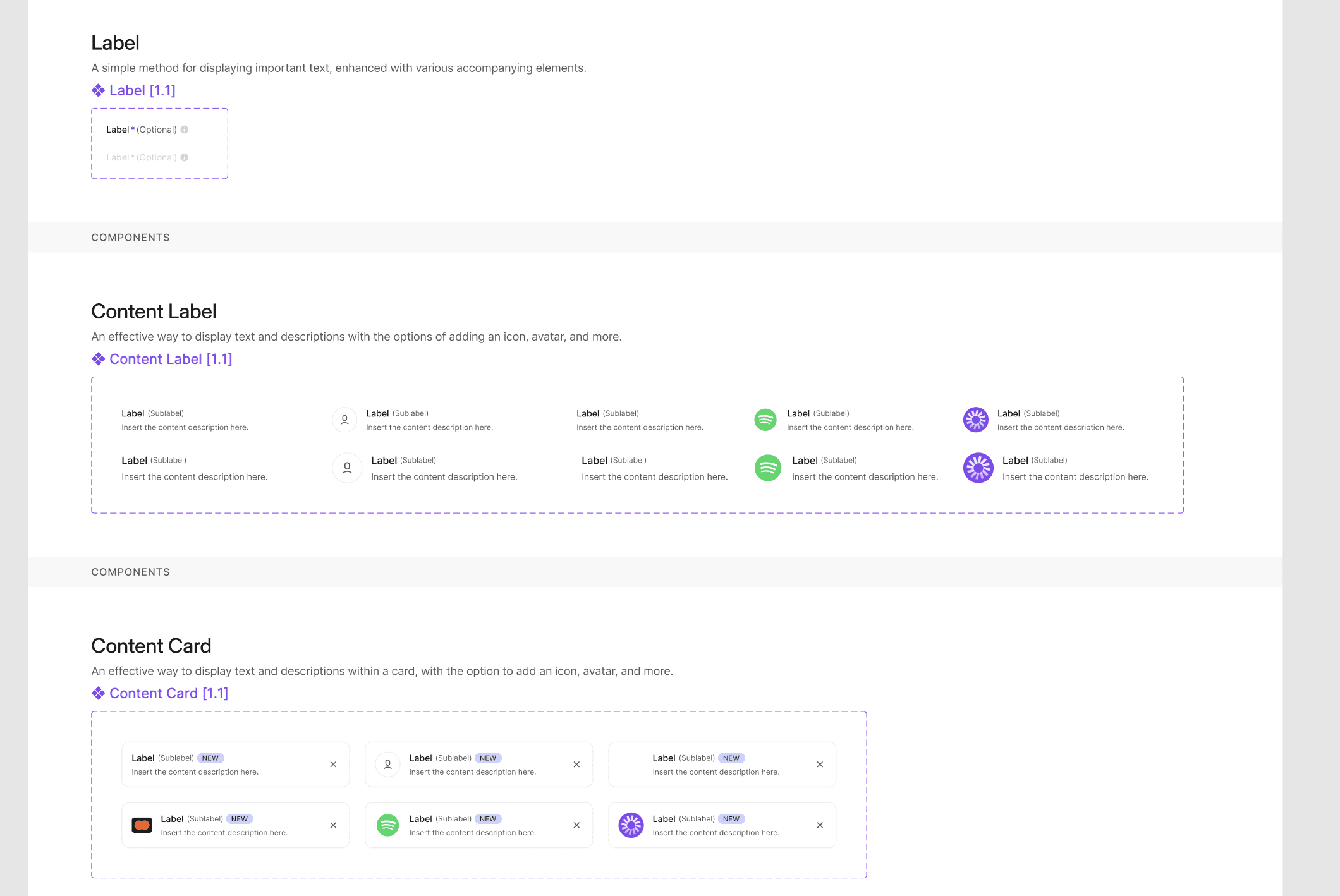
Creating a design system
I collaborated closely with the development team to build a scalable, component-driven design system using Next.js and Tailwind CSS. We established a shared token structure for color, spacing, and typography to ensure consistency across the platform including dashboards, validator workflows, and emissions reports. The system was modular, fully responsive, and optimized for reusability, allowing us to scale quickly while maintaining visual and functional coherence.
Final Designs
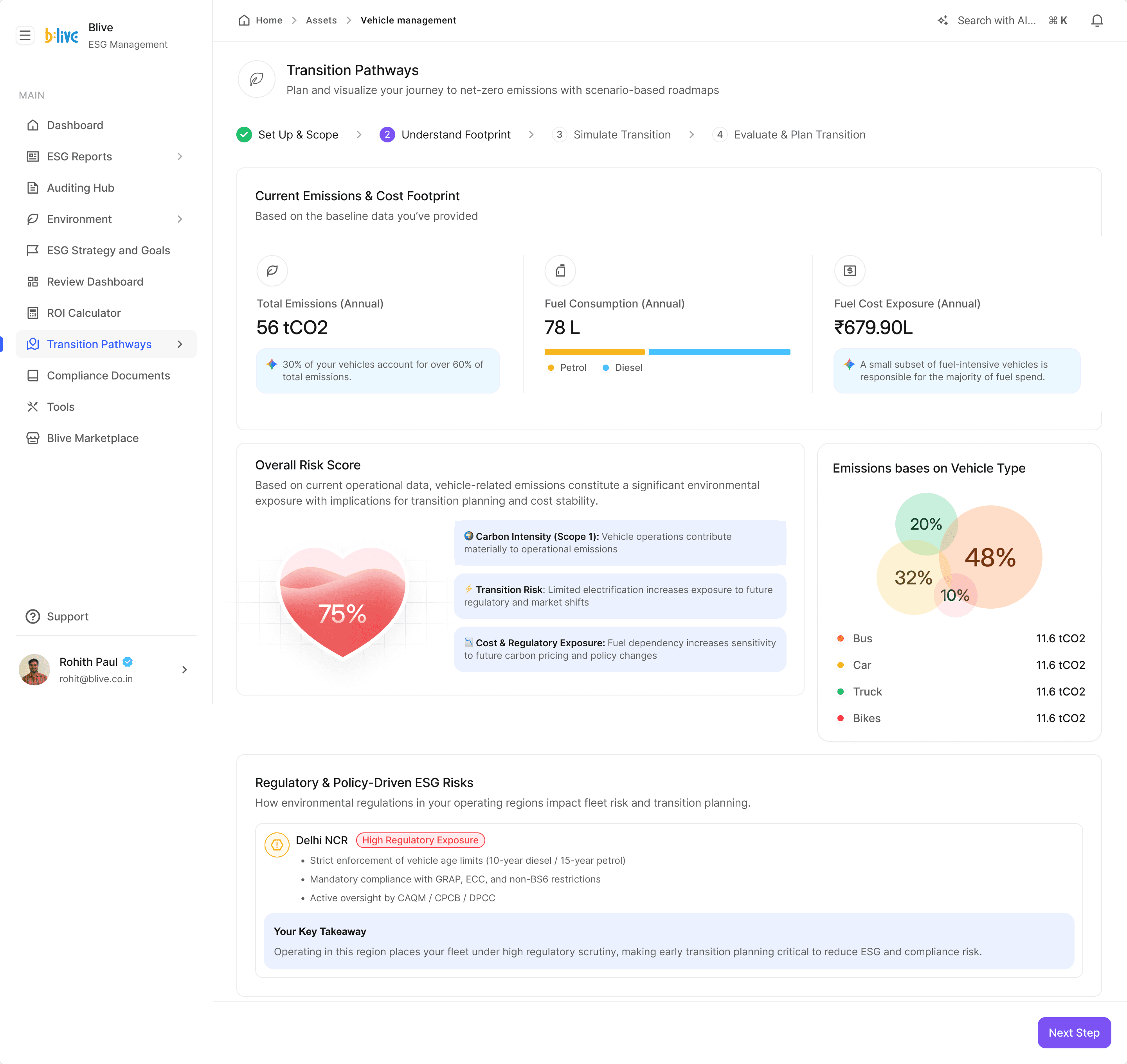
Carbon Footprint & Risk Intelligence
This feature is designed to help organizations establish a clear emissions baseline across their operations the foundation for any ESG transition strategy.
What It Does
Calculates your organization’s annual carbon emissions (Scope 1, 2, or 3)
Highlights cost and fuel hotspots across operations
Scores environmental risk based on intensity, exposure, and compliance factors
Breaks down emissions by asset, region, or category for targeted insights
Flags policy risks tied to location or industry
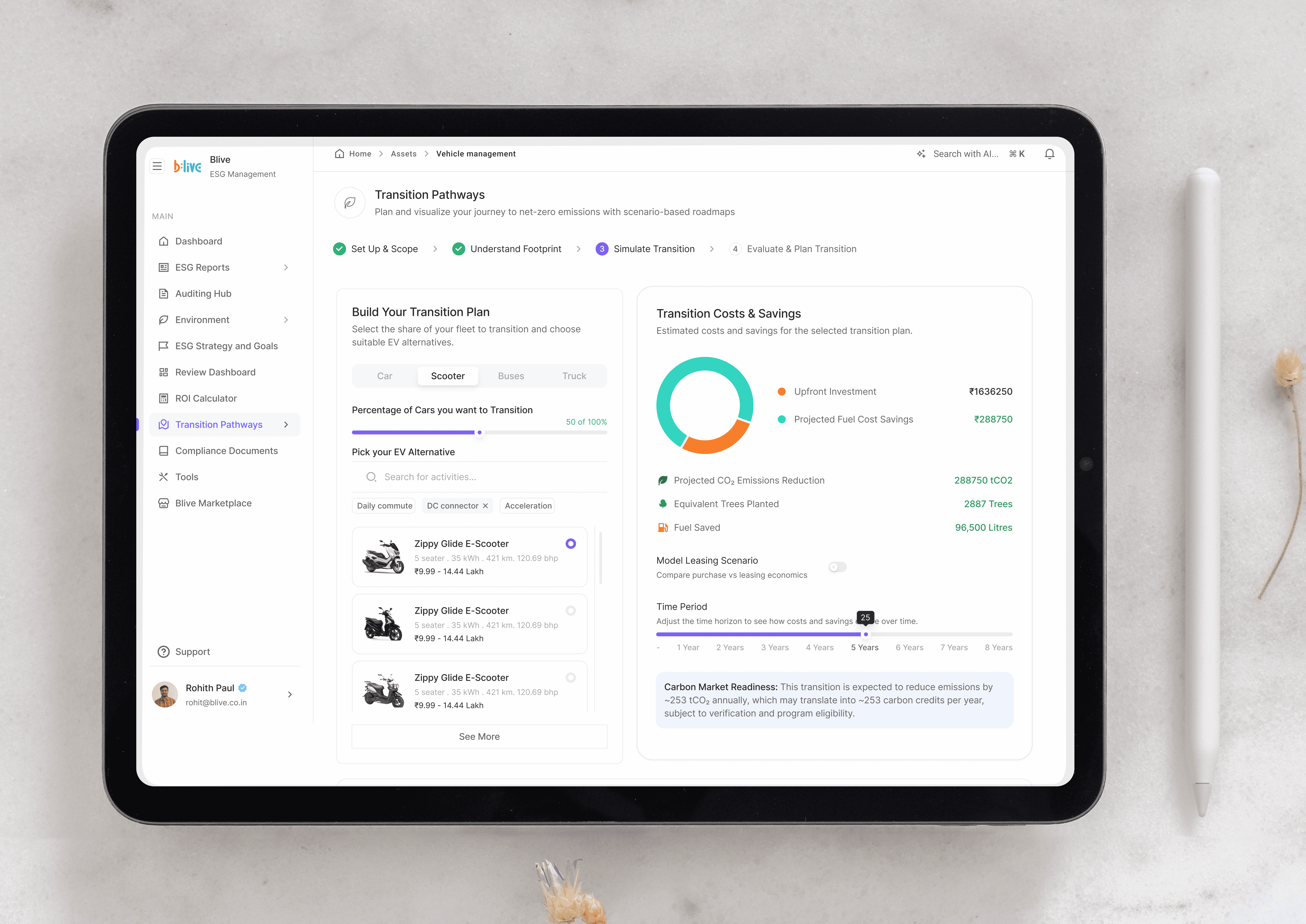
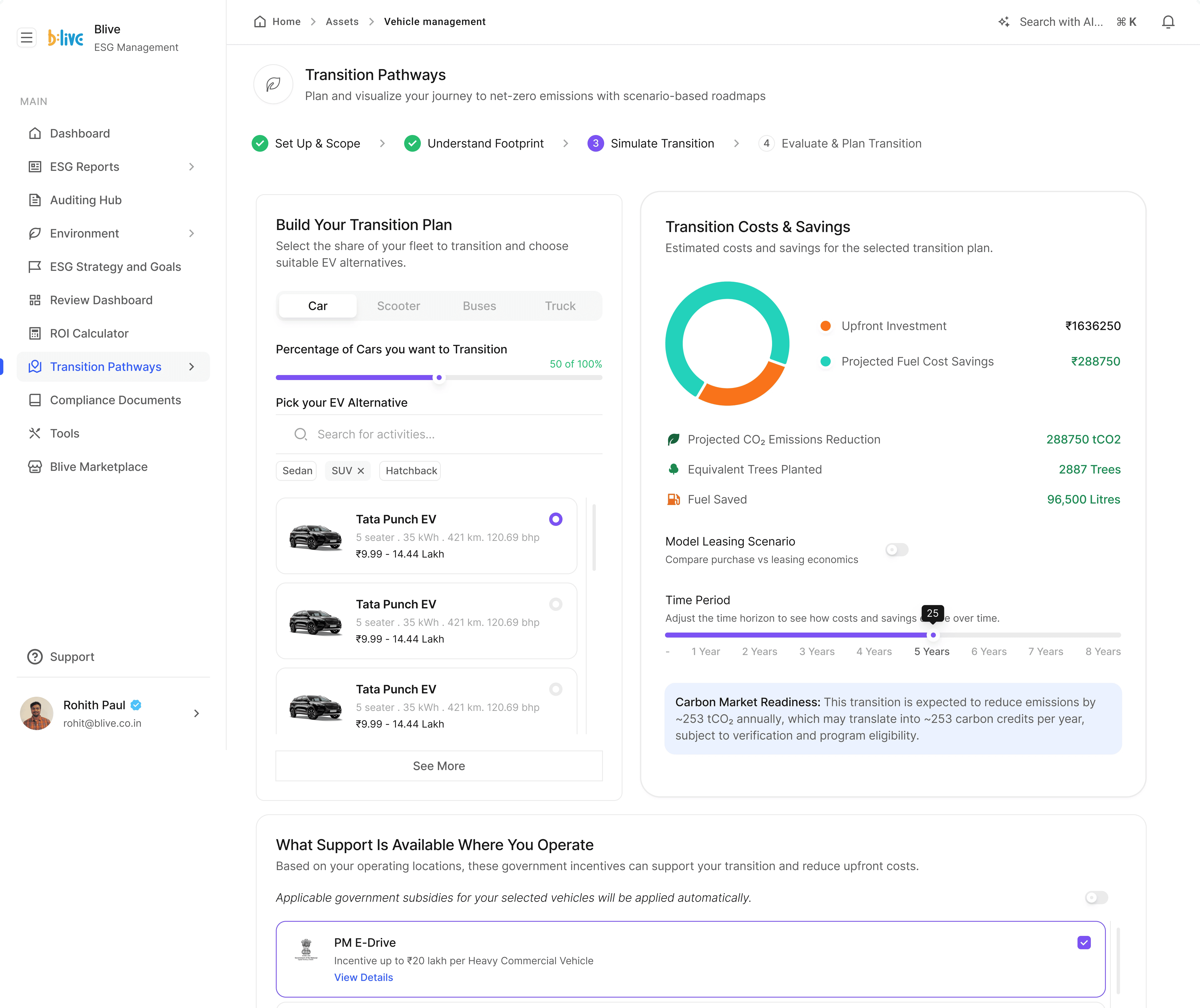
Simulate Transition
Helps users explore transition scenarios from fossil-fuel assets to sustainable alternatives and understand their long-term impact.
What It Does
Lets users configure how much of a category (e.g., cars, trucks, buildings) they want to transition
Surfaces costs vs. projected fuel savings dynamically
Shows environmental impact: CO₂ reduction, trees saved, fuel conserved
Includes a leasing vs. purchase toggle for financial comparison
Timeline slider helps simulate ROI over multiple years
Adds a Carbon Credit Readiness flag for offset markets
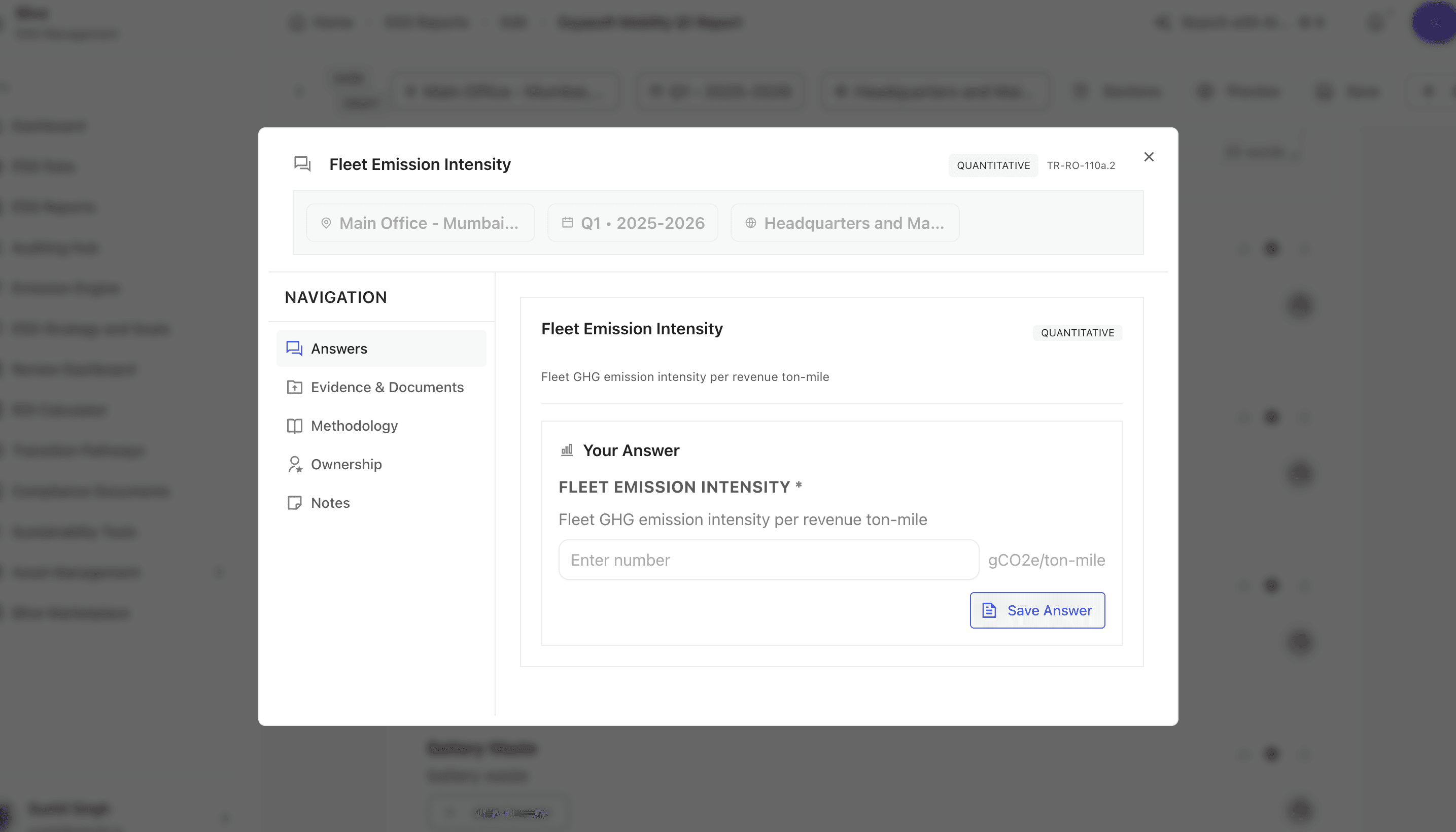
ESG Report Builder – MRV-Linked Input
This module lets users input or validate ESG data points in this case, fleet emission intensity pulled from automated MRV (Monitoring, Reporting, Verification) pipelines.
What It Does
Auto-fetches emissions data via MRV integrations
Allows manual override or confirmation for regulatory reporting
Tracks data provenance (ownership, documents, methodology)
Organizes disclosures by reporting framework (e.g., SASB, GRI, CSRD)
Conclusion
Future Directions
With core functionality for emissions tracking and transition modeling in place and initial pilots validating usability in the mobility sector the next phase focuses on deeper testing and broader ESG coverage:
Cross-Sector Validation
Expand pilot testing beyond logistics and mobility to sectors like manufacturing, retail, and finance to ensure platform adaptability across different ESG risk profiles and data environments.
Enhanced Social Metrics Tracking
Introduce features to track workforce diversity, employee well-being, community impact, and labor practices aligned with global frameworks like GRI and CSRD’s Social disclosures.Governance Module Development
Build tools for capturing board composition, policy disclosures, anti-corruption practices, and compliance workflows helping users strengthen internal governance visibility and risk controls.
Recognition
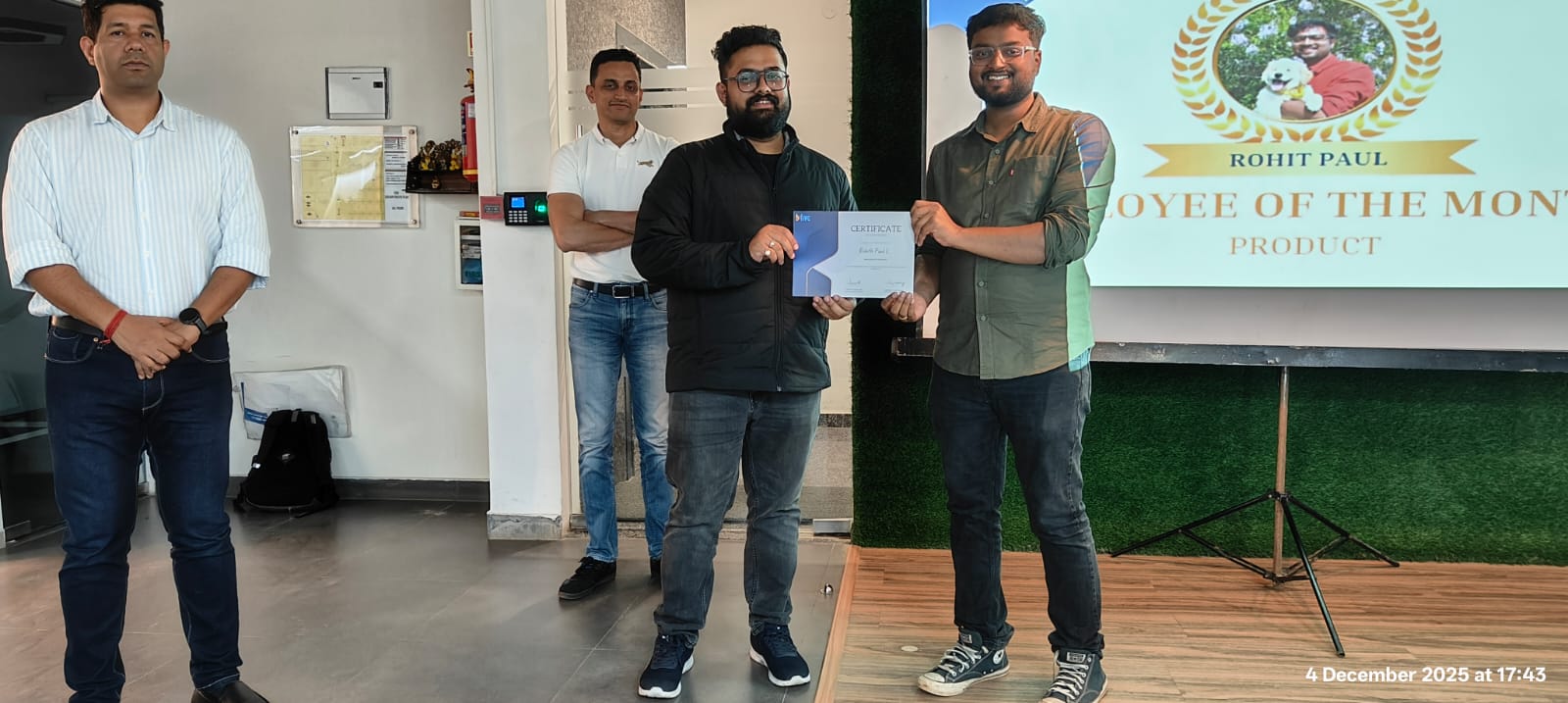
Awarded Employee of the Month for leading cross-functional development and pilot rollout of the ESG platform recognized for delivering measurable outcomes in a fast-paced 0→1 product environment..